

Before We Touch a Single Configuration Screen - The Questions I Ask First

By the time most people bring me in, they're ready to talk about the system. Modules, timelines, which partner is doing the build. Fair enough - that's usually what's top of mind.
But I've learned not to start there.
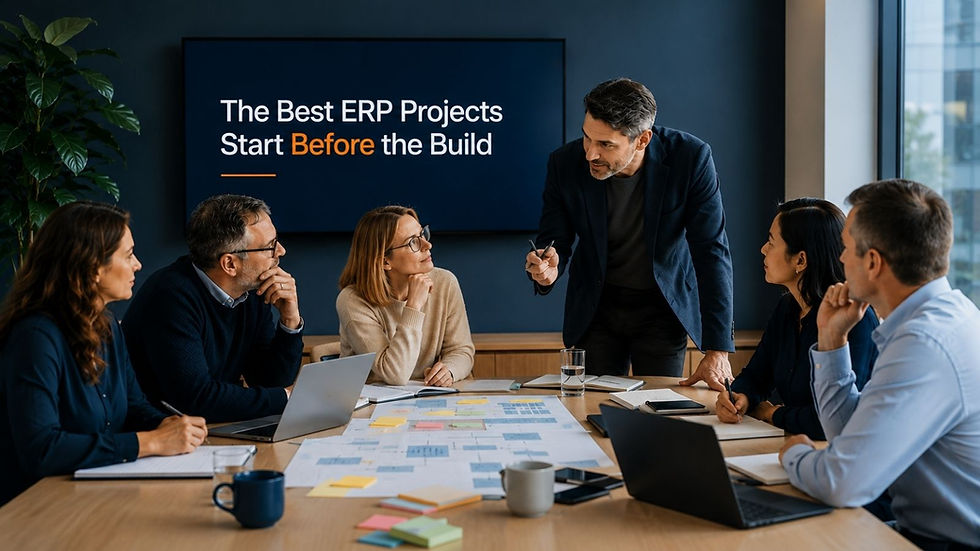
I've been lucky. I started my career on a successful, global ERP project where the relationships, the communication, the team-building were managed so well that I genuinely thought that was just the norm - that every project ran like that. Having a leader who makes sure project communications are consistent and well-structured, led by people who actually know how to engage a room, who also makes space for the social side, celebrating milestones, building culture - is part of what makes a team succeed. And I don't mean a pizza party in the office. I mean the real time and effort it takes for people to get to know each other and build enough trust that they feel safe speaking up, before and during the decisions that matter.
The projects that go well are rarely decided in the configuration screens. They're decided in the weeks before anyone opens the system - in whether the sponsor, the architects, the finance lead, and the people actually gathering the requirements and doing the work are aligned on what "done" looks like, what "excellent" looks like, and how to get help when they need it. That's the gap I'm brought in to help close - sitting on the client's side of the table, as an independent, experienced channel between the business and the vendor or implementation partners.
So before we get anywhere near a build, here's what I like to know.
The Five Questions I Ask Before Kickoff
1. What is your current process list and do you have a vision of your to-be processes?
Whether you're starting from scratch on a greenfield implementation or augmenting existing processes, or even a hybrid of the two – your process list is one of the most important project assets and will shape the change management approach for your project. If you are clear about your current process list and have a vision of where you want to be, we can much more easily identify areas that have a high degree of change and impact for your business, and focus our efforts on those – it’s usually where we can mitigate a lot of the risks from a change management perspective.
2. What problems are you trying to solve on this journey?
A lot of companies come to a new ERP because a legacy system's support is expiring - or already has. Others want a full redesign and re-architecture of how the business runs. If we stay focused on the actual problems we're solving, we avoid overcomplicating the scope.
3. Who would you nominate as your change champions?
At least one per major workstream. A sponsor with a solid team of people who will genuinely advocate for the incoming change gives the whole project a foundation to build on - and market internally.
4. How do you picture the go-live weekend and first week?
I like to ask people to imagine the first week of transacting in production - what the communications to the business look like, how the "big go-live" moment gets revealed, what kind of celebration they picture once that first successful week is behind them. It sounds like a small question. It tells me an enormous amount about the culture, and where the business's priorities sit.
5. Who do you see being part of your Centre of Excellence after go-live?
Call it a CoE, an ERP maintenance team, a Change and Transformation Hub - whatever fits your business. These are the people who'll understand the configuration and support the system once everyone else returns to business as usual. It's one of the most overlooked parts of ERP budgeting and planning - but having a clear vision of that end state early, shapes how the whole project runs: the analysis, the build, the testing, the training.
Why I Ask These Before the "What"
None of these questions are about the technology. They're about whether the organisation is set up to actually get value out of it once it's live.
I've worked on implementations where building an internal Centre of Excellence was the intention from day one - and it shows. Teams like that are more engaged, more accountable, because people feel like they're genuinely part of the decision-making, not just recipients of it. I've also been part of programmes where the plan was always there on paper, but the resource onboarding happened far too late to capture the value that gets built during the implementation itself. The reliance on external consultants dragged on, and the internal team missed out on learning things they should have owned from the start.
How we design change and project management shifts with the scope, the culture, and the size of the organisation - but the fundamentals stay the same.
That's the value of having someone independent in the room early: not selling implementation hours, not tied to a single vendor, just focused on the outcome that you, the client, needs.
If You're About to Start an ERP Project
If you're heading into a D365 F&O, SCM implementation, whether it's your first or your fifth, these are worth answering honestly, well before the kickoff meeting, not after go-live when the gaps start to show.
If you'd like to talk about how ERP Advisers can help you manage the change that comes with an ERP implementation, get in touch.


Comments